
Rep Max Calculator
You don’t need to test a true one-rep max to train by percentages. Enter a weight and the number of clean reps you managed, and this calculator estimates your one-rep max (1RM) with seven well-known formulas, shows the average, predicts your maxes for other rep counts, and builds a percentage table rounded to the plates you have.
- Free to use
- No sign-up
- Runs in your browser
One-rep max calculator
Strength Training Log Pack
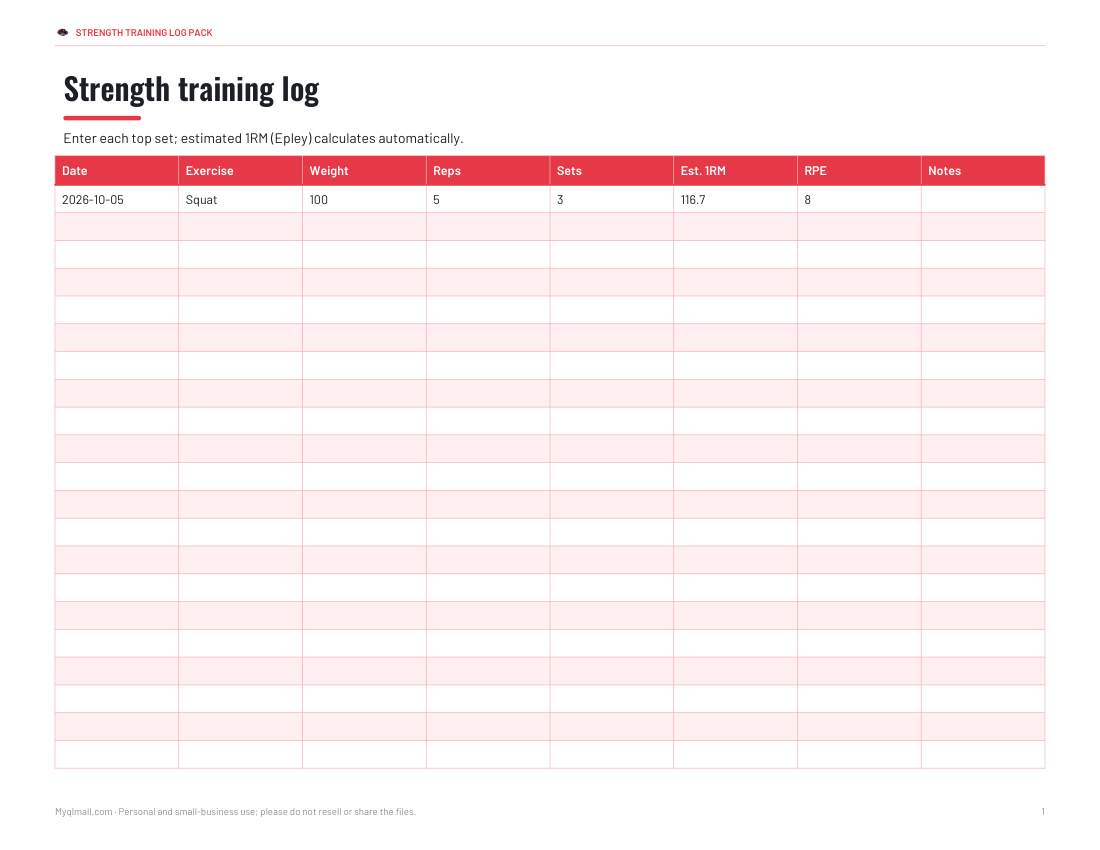
Excel training log with automatic 1RM estimates, a printable percentage chart, a personal-records tracker and a 12-week programme planner.
- Training log (XLSX)
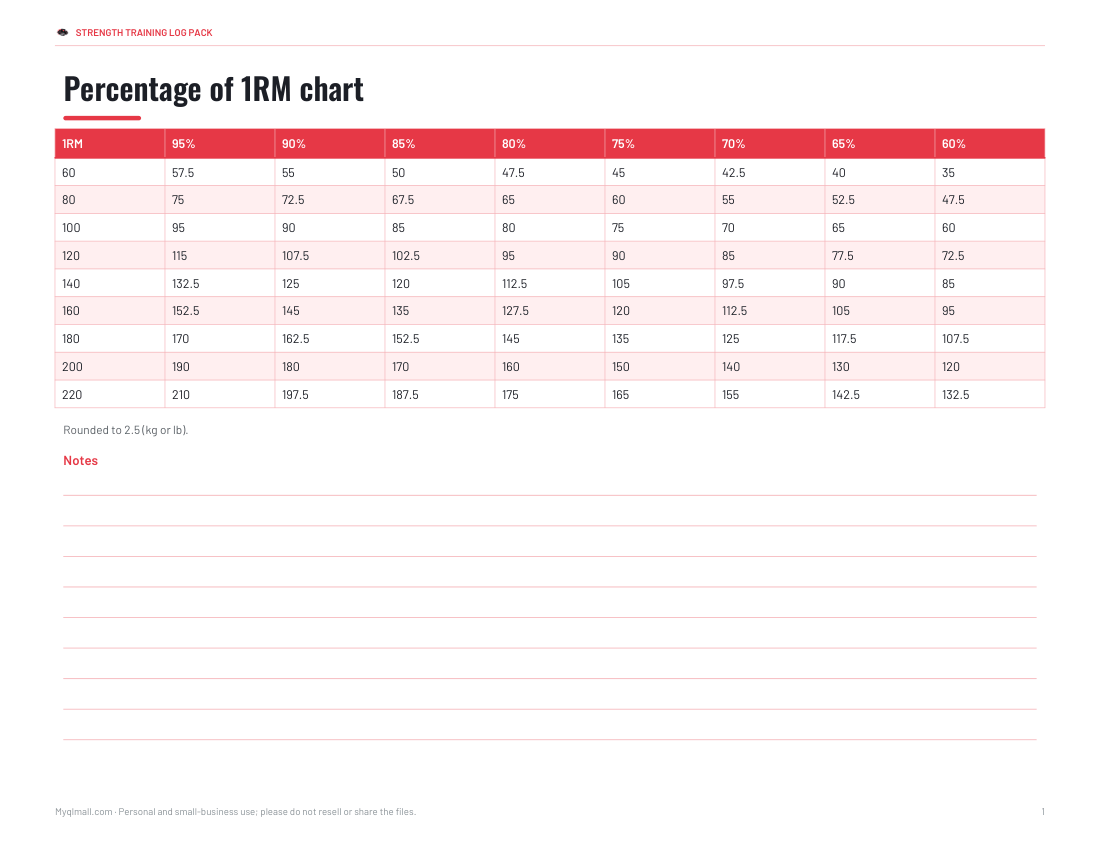
- Percentage chart (PDF/XLSX)
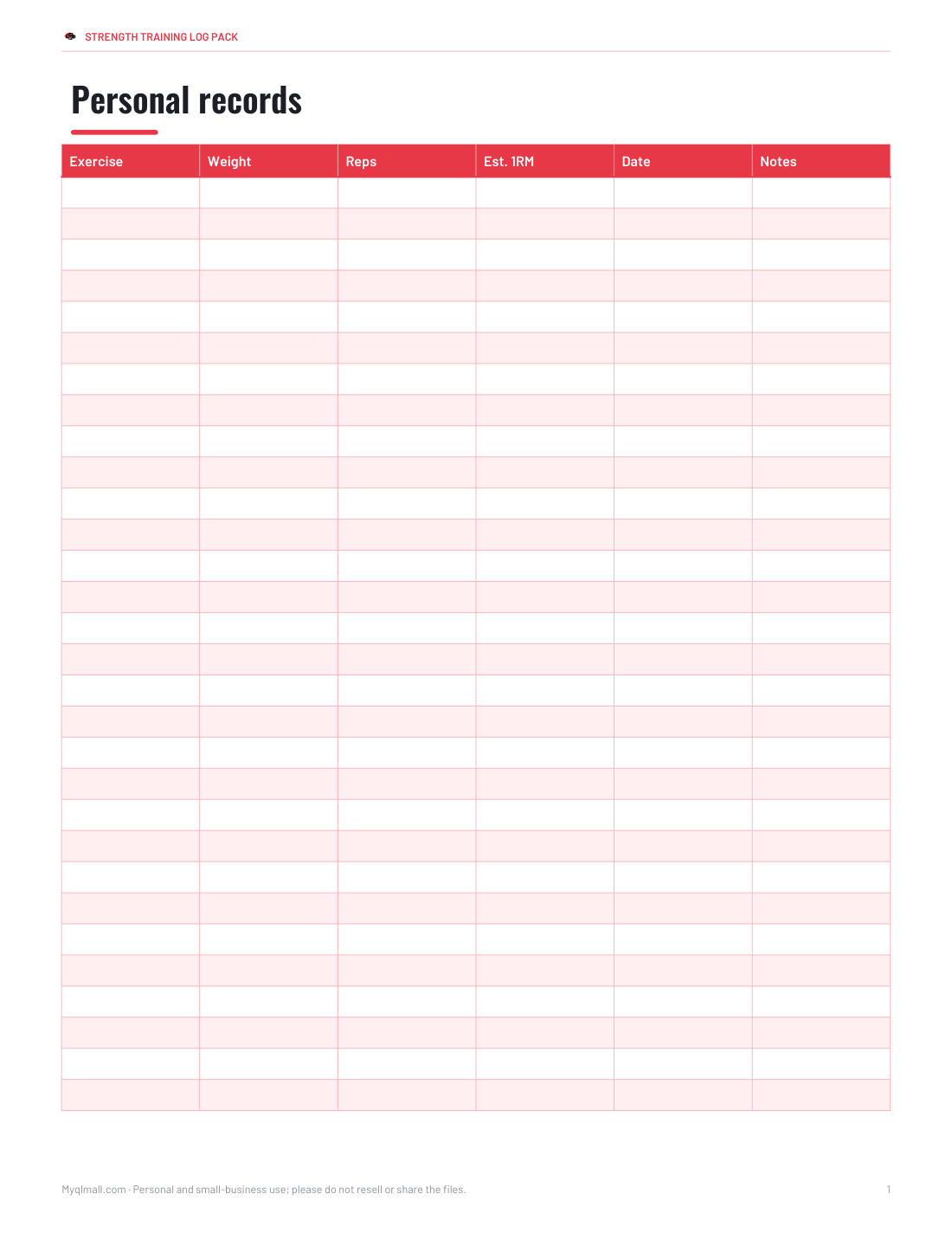
- PR tracker (PDF/DOCX/XLSX)
- 12-week planner (PDF/XLSX)
Formats: XLSX, PDF, DOCX. Instant download after payment (link valid 72 hours, up to 5 downloads). AI-assisted: the templates were drafted with AI help and reviewed and laid out before publishing.
$5.00 USD, one-time 4 files · about $1.25 each
- Instant download
- 7-day refund
- Secure checkout by Stripe
7-day money-back guarantee. Full refund within 7 days of purchase, even after you download.
Free sample: Training Log 1RM (PDF, 75 KB)
Full refund within 7 days — see the refund policy and license.
Free printables
Single sheets you can print right now, no sign-up. The full pack adds every sheet in one download plus the editable files.
 Printable Strength Training Log
 Printable 1RM Percentage Chart
 Printable PR Tracker
 Printable 12-Week Training Planner
What is a one-rep max?
Your one-rep max (1RM) is the heaviest weight you can lift once with good form for a given exercise. Many strength programmes prescribe weights as a percentage of 1RM — 5 sets of 5 at 80%, for example — so knowing it helps you choose the right loads. Testing a true 1RM is tiring and carries more risk, so most people estimate it from a set of several reps instead.
The formulas
| Formula | Equation (w = weight, r = reps) |
|---|---|
| Epley | w × (1 + r/30) |
| Brzycki | w × 36 / (37 − r) |
| Lombardi | w × r^0.10 |
| Mayhew et al. | 100w / (52.2 + 41.9e^(−0.055r)) |
| O’Conner et al. | w × (1 + 0.025r) |
| Wathan | 100w / (48.8 + 53.8e^(−0.075r)) |
| Lander | 100w / (101.3 − 2.67123r) |
Each formula was fitted to data from different groups of lifters and exercises, so they disagree slightly. Averaging them smooths out the differences; the range shows how much uncertainty there is.
Worked example
| Formula | 100 kg × 5 reps |
|---|---|
| Epley | 116.7 kg |
| Brzycki | 112.5 kg |
| Lombardi | 117.5 kg |
| Mayhew | 119.0 kg |
| O’Conner | 112.5 kg |
| Wathan | 116.6 kg |
| Lander | 113.7 kg |
| Average | about 115.5 kg |
Rounded to 2.5 kg plates, 80% of that estimate is about 92.5 kg — a typical working weight for sets of five.
Percentage of 1RM and typical reps
| % of 1RM | Typical reps possible | Training focus |
|---|---|---|
| 100% | 1 | Maximal strength |
| 95% | 2 | Strength |
| 90% | 3–4 | Strength |
| 85% | 5–6 | Strength / hypertrophy |
| 80% | 7–8 | Hypertrophy / strength |
| 75% | 9–10 | Hypertrophy |
| 70% | 11–12 | Hypertrophy / endurance |
| 65% | 15 or so | Muscular endurance, technique |
These relationships vary between people and exercises — lifters often manage more reps at a given percentage on leg exercises than on upper-body lifts.
Getting a good estimate
- Use a set of about 3–8 reps taken close to failure with good form.
- Count only clean reps — no bounces, half reps or help from a spotter.
- Estimate each lift separately: squat, bench, deadlift and overhead press all differ.
- Re-estimate every few weeks as you get stronger.
- For beginners, technique matters far more than an exact number.
Using the calculator
- Choose kg or lb and the smallest jump your plates allow.
- Enter the weight and the reps you completed.
- Read the average estimate and the range.
- Use the percentage table for your programme’s working sets.
- Download the table as CSV to keep in your training log.
Rep max, RPE and reps in reserve
Many programmes now use RPE (rating of perceived exertion) or RIR (reps in reserve) alongside percentages. An RPE 10 set is a true maximum; RPE 8 means you could have done about two more reps. A set of 5 at RPE 8 is roughly a 7-rep max effort, so you can estimate your 1RM by entering the reps you could have done, not just the reps you did. Percentages and RPE work well together: percentages set the plan, RPE adjusts it on the day.
Warm-up sets before a heavy set
| Set | Load | Reps |
|---|---|---|
| 1 | Empty bar or about 40% of 1RM | 8–10 |
| 2 | About 50–55% | 5 |
| 3 | About 65–70% | 3 |
| 4 | About 75–80% | 2 |
| 5 | About 85% | 1 |
| Work sets | Programme weight | As planned |
A progression like this raises body temperature and grooves technique without tiring you before the working sets. Use the percentage table to fill in the exact weights for your estimate.
How strength changes over time
Beginners can often add weight to the bar every session for weeks; intermediate lifters progress week to week; experienced lifters may take months to add a few kilograms to a 1RM. Recording your top sets and estimated maxes in a log shows the trend even when individual sessions go up and down with sleep, stress and nutrition.
Safety
Warm up thoroughly, use collars and safety bars or a spotter for heavy sets, and stop a set when form breaks down. If you have an injury or a medical condition, ask a qualified coach or healthcare professional before heavy lifting.
Training log pack
The optional pack includes an Excel training log that estimates 1RM from each top set (Epley) and charts progress, a printable percentage chart, a personal-records tracker and a 12-week programme planner. The calculator above is free.
AI-assisted content
This page was drafted with AI assistance and reviewed before publishing. Estimates are approximations, not guarantees of what you can lift.
Frequently asked questions
How do I calculate my one-rep max?
Enter a weight and the reps you completed; the formulas estimate your 1RM.
Which 1RM formula is most accurate?
None is best for everyone; averaging several is a sensible approach.
How many reps should I use to estimate?
About 3–8 reps near failure gives the most reliable estimate.
What percentage of 1RM should I train at?
Commonly 70–85% for most working sets, depending on your goal.
Is it safe to test a true 1RM?
It can be, with experience, good technique and safety equipment; estimates avoid the risk.
Does it work in pounds?
Yes, switch the units to lb.
How often should I re-estimate my 1RM?
Every four to eight weeks, or whenever your working sets feel noticeably easier.
Why do the formulas give different answers?
They were fitted to different groups of lifters and rep ranges; the spread shows the uncertainty.
Can I use it for machines and dumbbells?
Yes, as a rough guide, though estimates were developed mainly for barbell lifts.